


| Name | Yun-Ru (Ruby) Chen, Ph.D. |
|---|---|
| Incumbent | Professor |
| 所屬單位 | Deputy Director Exploring the complexities of protein misfolding and amyloid diseases, our research seeks to clarify the pathological mechanisms of neurodegenerative disorders. Utilizing biochemistry, biophysics, and molecular cell biology, we investigate amyloid aggregation, toxicity, and glycation, with a focus on Alzheimer's and Parkinson's. Ph.D., Department of Molecular and Structural Biochemistry, North Carolina State University, USA, 1998-2003 B.S., Department of Agricultural Chemistry, National Taiwan University, Taiwan, 1992-1996 |
| NCLscan: |
|
| 研究方向/領域 |
RESEARCH INTERESTSProtein Folding/Misfolding, Amyloids, and Neurodegenerative Diseases My research focuses on understanding the mechanism of protein misfolding diseases, amyloidosis, by various techniques including biochemical, biophysical, molecular, and cellular methods. Our long-term goal is to elucidate the disease mechanisms of amyloidosis in the aspects of protein folding and structure, pathogenic protein interactions, and relate the results to the medical consequences. We further utilize the knowledge to develop novel diagnostic means and therapeutic modalities. Many ageing-related neurodegenerative diseases such as Alzheimer’s disease (AD) and Parkinson’s disease (PD) belong to amyloidosis. Among them, AD is the most serious problem in the 21st century. Amyloidosis is caused by aggregation of misfolded proteins to form amyloid fibrils comprising specific cross-β structures. Amyloid oligomers that exist in several neurodegenerative diseases imply a common toxicity mechanism in different neurodegenerative diseases. Currently, we are working on three amyloid and amyloid-like proteins and their interacting partners in neurodegenerative diseases. They are amyloid-β (Aβ) peptide and tau protein, the major substance in senile plaques and neurofibrillary tangles of AD patients respectively, α-synuclein, the component of Lewy bodies in PD, and TDP-43, a novel inclusion found in a subtype of frontotemporal lobar dementia (FTLD-U), amyotrophic lateral sclerosis (ALS), and AD. We start from elucidating the mechanism of such aggregation and further developing the diagnostic method, antibodies, and small molecule inhibitors. Moreover, we study the structure, function, and interactions of the related glycan conjugates, precursor proteins, and modifiers. The major research interests are listed as follows:
Amyloid formation, a detrimental protein aggregation, is initiated by protein misfolding followed by self-association to ultimately form amyloid fibrils. The discovery of cytotoxic pre-fibrillar oligomers in many neurodegenerative diseases underscores the importance of understanding the folding, aggregation, and pathogenic mechanisms as well as developing diagnostic and therapeutic methods. 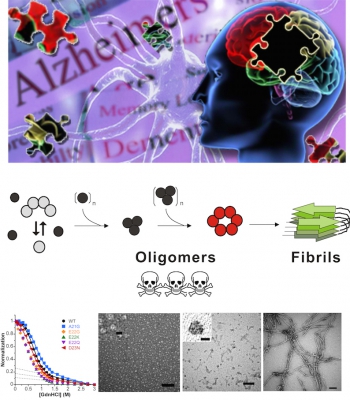 |
EDUCATION AND POSITIONS HELD
- 2023-present Deputy Director, Genomics Research Center, Academia Sinica
- 2022-present Adjunct Professor/ Adjunct Research Fellow, Biomedical Translation Research Center, Academia Sinica, Taiwan
- 2022-2025 President, Asia Pacific Protein Association (APPA)
- 2021-present Adjunct Professor, Dept. of Biochemical Science & Technology, National Taiwan University, Taiwan
- 2021-present Professor, The Genomics Research Center, Academia Sinica
- 2015-present Adjunct Associate Professor, Dept. of Biochemical Science & Technology, National Taiwan University, Taiwan
- 2014-2021 Associate Professor, The Genomics Research Center, Academia Sinica
- 2015-2019 The World Academy of Sciences (TWAS) Young Affiliate
- 2014-2017 Council Member of Asia Pacific Protein Association (APPA)
- 2007-2014 Assistant Professor, Genomics Research Center, Academia Sinica, Taiwan
- 2006-2007 Postdoctoral Fellow, Genomics Research Center, Academia Sinica, Taiwan
- 2004-2002 Postdoctoral Fellow, Dept. of Molecular Biology & Biochemistry, University of California, Irvine, USA
HONORS
- 2024 The 21th National Innovation Improvement Award. “A novel conformation-dependent monoclonal antibody against ALS and related neurodegenerative diseases”
- 2024 National Biotechnology Research Park Demo Day, The Investment Award.
- 2023 Awarded by Boehringer Ingelheim’s BioMedicine Innovation Program
- 2023 NBRP PITCH DAY Potential Team Award “A novel therapeutic monoclonal antibody against ALS and related neurodegenerative diseases”
- 2023 Outstanding Award by Chung Hwa Rotary Education Foundation, 2022-2023.
- 2023 Investigator Project Grant, Academia Sinica
- 2022-2023 Chung Hwa Rotary Education Foundation Outstanding Award
- 2022 The 19th National Innovation Award. “A novel conformation-dependent monoclonal antibody against ALS and related neurodegenerative diseases”
- 2021 The 19th Y. Z. Hsu Scientific Paper Award, Far Eastern Y. Z. Hsu Science and Technology Memorial Foundation
- 2019 National China Youth Corps Youth Medal, Taiwan
- 2018 Selected work for Future Tech Exhibition “A novel potential therapeutic antibody to combat ALS and related neurodegenerative diseases”
- 2018 The 14th Young Investigator Award, TienTe Lee Biomedical Foundation
- 2017 Career Development Award, Academia Sinica
- 2016 Young Chemists Award of the Chemical Society, Taipei
- 2015 Ta-You Wu Memorial Award
- 2015-2019 TWAS Young Affiliate, East & Southeast Asia and Pacific Region
- 2015 The 13th Y.Z. Hsu Scientific Paper Award
- 2015 Academia Sinica Research Award for Junior Research Investigators
- 2015 Junior Faculty Award, the 12th International Conference on Alzheimer’s Disease and Parkinson’s Disease
- 2014 Promising Women in Science Award, Wu Chieh Shiung Education Foundation
- 2013 Young Investigator Award, Biophysical Society of R.O.C.
- 2012 Taiwan Dementia Society, LiFu Medical Research Foundation Academic Award, Advisor of the 1st Price
- 2012 The Taiwan Society for Biochemistry and Molecular Biology Traveling Fellowship
- 2011 Taiwan Dementia Society, LiFu Medical Research Foundation Academic Award, Advisor of the 2nd Price
- 2006-2007 Academia Sinica Postdoctoral Fellowship
Curbing TDP-43 May Ease the Alzheimer's Disease Progression
- 2025/01 https://news.gbimonthly.com/tw/magazine/article_show.php?num=73949
- 2024/03/18 Sulfated Disaccharide Reduces Neuronal Degeneration. A New Approach to Treating Amyotrophic Lateral Sclerosis and Frontotemporal Dementia
- 2024/03/08 Dr. Yun-Yu (Ruby) Chen awarded Boehringer Ingelheim’s Biomedicine Innovation Program
- 2020/11/27 Curbing TDP-43 May Ease the Alzheimer’s Disease Progression
- 2014/11/14 An interview with CTS News Magazine
- 2014/09/16 Full-length TDP-43 Antibody Confirms Human FTLD
- 2012/10/12 Nagatively Charged Gold Nanoparticles Proved to Ease the Accumulation of Proteins Causing Alzheimer’s Disease