

Legume lectins are proteins produced by plants in the bean family that binds to sugars, and are often used by the plant for self-defense or signaling. Some legume lectins, like ricin, are incredibly poisonous while others, like ConA, have an array of biomedical properties that make them powerful tools in glycobiology and medicine.
One problem that has stumped researchers up until now is the inability to produce these powerful tools recombinantly. Without a recombinant version of legume lectins that can function as it does in nature, it is hard to study these sugar-binding proteins or try to change its characteristics to better suit our needs.
The reason recombinant versions of legume lectins are difficult to produce is because a lot of these proteins are not typically produced by the plant in its active form, but as inactive “pro-lectins” that only get activated after a complex series of steps. This actually makes a lot of sense for the plant, as these agents of self-defense are not only toxic for animals trying to eat the plant but the plants themselves as well, so they only activate these pro-lectins once they are safely stored in a secure organelle. This, however, presents a big problem for scientists who are trying to produce these lectins recombinantly, because when they attempt to make these proteins, they will only get the inactive “pro-lectin” and not the final active form.
Recently, a research team led by Dr. Che Ma at Academia Sinica Genomics Research Center tries to tackle this problem by first figuring out what turns an inactive pro-lectin active. Using cryo-electron microscopy, Dr. Ma’s group examined the protein structure of an inactive pro-lectin from the hyacinth bean (Lablab purpureus). What they found was surprising: there is already a sugar stuck inside the protein’s sugar binding site! With a sugar already occupying the space that is normally used to bind to sugars, the protein is therefore unable to interact with other sugars like an active lectin would. This stuck sugar is a “self-ligand”, meaning it originates from part of the protein itself, and binds to the active part of the protein rendering the entire protein inactive. Think of it as the lynchpin on a grenade, something you have to pull out to make the grenade live.
To “pull out” this lynchpin on hyacinth bean’s pro-lectin, Dr. Che Ma’s group tried a variety of sugar-cutting and protein-cutting enzymes. In the end one enzyme, the sugar-cutting PNGase F, succeeded. The hyacinth bean’s pro-lectin, pro-FRIL, became the active lectin FRIL after PNGase F treatment. Not only does this method work on the hyacinth bean’s pro-lectin, but the pro-lectin from jackbean as well (pro-ConA), meaning this method is likely to work on inactive pro-lectins from a variety of legume plants (Figure 1).
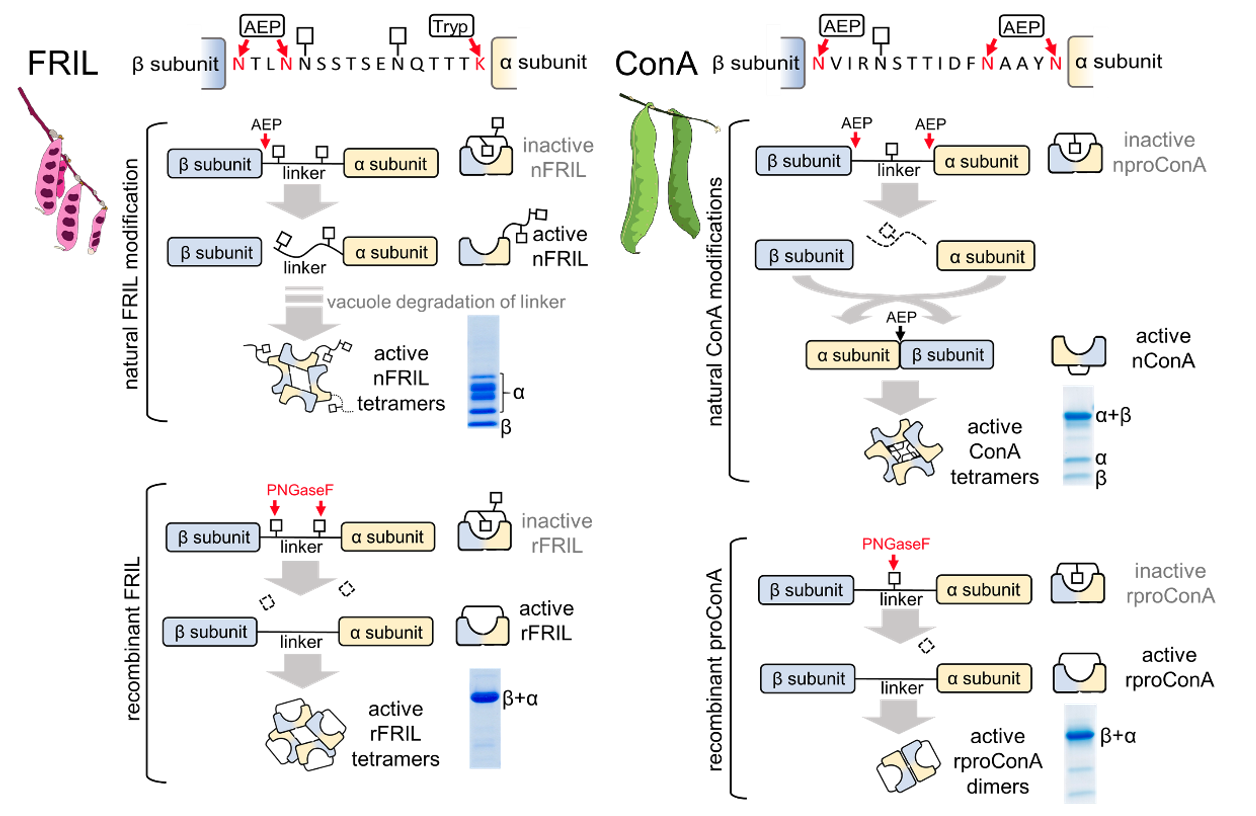
Figure 1: Activation of natural (top) and recombinant (bottom) legume lectins FRIL and ConA.
Having cleared the major hurdle that has hindered research on legume lectins, Dr. Ma’s team was then able to get down to the fun stuff: swapping out amino acid residues on hyacinth bean’s lectin FRIL and seeing what happens. As expected, most of the time changing residues that interact with sugars just causes the lectin to stop functioning entirely, but a few residues on a section of the lectin named “loop B” had a completely different effect: they altered the types of sugars the lectin recognizes!
Normally, the hyacinth bean lectin FRIL binds to a type of sugar called “complex type N-glycans”. However, FRIL lectins with swapped amino acid residues in loop B started recognizing “oligomannose N-glycans” as well as complex type N-glycans. As Dr. Ma’s team continues to tinker with the recombinant hyacinth bean FRIL lectin, swapping out and inserting more and more amino acid residues on loop B, the lectin started to preferentially recognize oligomannose N-glycans over its original complex type N-glycan. Finally, a heavily-altered lectin, with 3 residue swaps and 2 residue insertions, switched over to oligomannose N-glycans entirely. This newly-engineered FRIL lectin was named “oligomannose-specific FRIL” by Dr. Ma’s team, or OMS-FRIL for short (Figure 2).
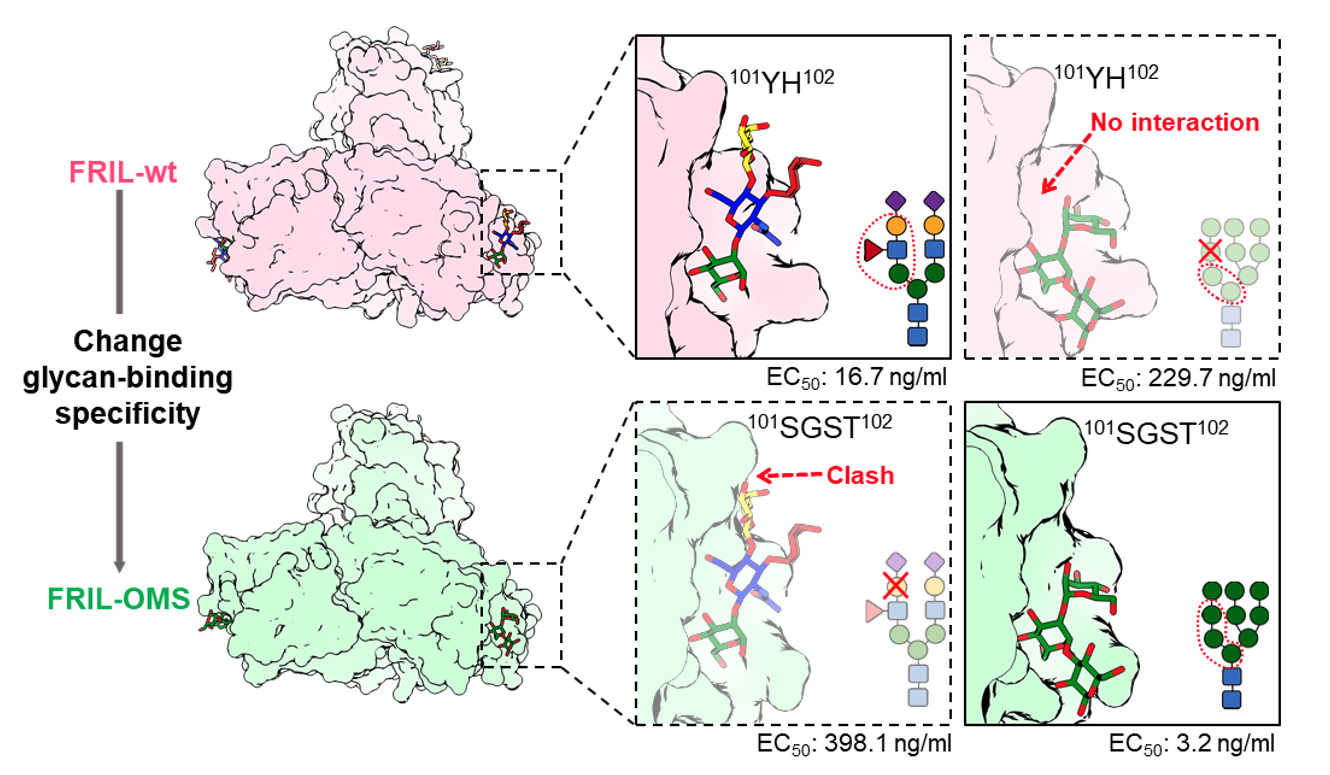
Figure 2: Glycan specificity of wild-type FRIL (top) and recombinant FRIL-OMS (bottom)
Aside from being a really fun series of experiments to conduct, this study by Dr. Ma does have real world implications. Many proteins in the legume lectin family have important biotechnological applications such as glycoprotein isolation, lectin microarrays and exosome characterization. For instance, the legume lectin featured in this study, FRIL from hyacinth bean, has antiviral properties that can be harnessed against influenza virus and SARS-CoV-2 (Report: FRIL Can Grab the Thorny Crown to Fight Off COVID-19). The ability to produce recombinant lectins (as opposed to harvesting and purifying them from their respective plants) would reduce heterogeneity and enhance utility. From a broader perspective, while protein-protein interactions have been studied extensively, protein-sugar interactions are less well-known. Yet altered sugar recognition underlie many of the risks humanity face today, such as the transmission of H5N1 influenza virus across different species. By exploring the mechanisms of how lectins bind to different sugars, Dr. Ma’s study provides greater insight into protein-sugar interactions.
First authorship on this study is shared by postdoctoral researchers Yo-min Liu and Hong Thuy Vy Nguyen, co-authors include Chien-Tai Ren, Xiaorui Chen, Md. Shahed-Al-Mahmud, Ting-Hua Chen, Kuo-Shiang Liao, Jennifer M. Lo, and Tzu-Chun Kan. The full paper, titled “Altering the Carbohydrate-Binding Specificity of the Legume Lectin FRIL Through Structure-Guided Engineering”, can be accessed with the following link: https://www.nature.com/articles/s41467-026-70188-7