

Ovarian clear cell carcinomas (OCCC), particularly cases retaining wild-type ARID1A expression, are chemo-resistant and lack specific therapies. We identified circadian gene BMAL2 as a critical oncogene that promotes OCCC tumorigenesis by preventing endogenous DNA damage.
BMAL2 depletion suppressed expression of homologous recombination DNA repair genes, including RAD51, leading to accumulated DNA double-stranded breaks, decreased cell viability and reduced tumor growth. This dependence on BMAL2 to maintain DNA integrity and cell viability can be a new route to suppress OCCC. Consistent with this idea, we found that small molecule GW833972A bound and facilitated BMAL2 degradation. GW833972A is effective by itself at high dose and can also be used at lower dosages to enhance the effectiveness of PARP inhibitor to suppress OCCC tumor growth. Together, our findings reveal an essential oncogenic role of BMAL2 and demonstrate that it is an appealing therapeutic target for OCCC.
Supported by Academia Sinica and the National Science and Technology Council, this study was led by Dr. Wendy W. Hwang-Verslues (Genomics Research Center, Academia Sinica) with PhD student Grace Y. T. Tan (TIGP-MCB, Academia Sinica/NDMU) as first author. The findings were published in EMBO Molecular Medicine on April 3, 2026.
The full paper, titled “BMAL2 is a druggable target for ovarian clear cell carcinoma (OCCC)”, can be accessed with the following link: https://link.springer.com/article/10.1038/s44321-026-00414-8
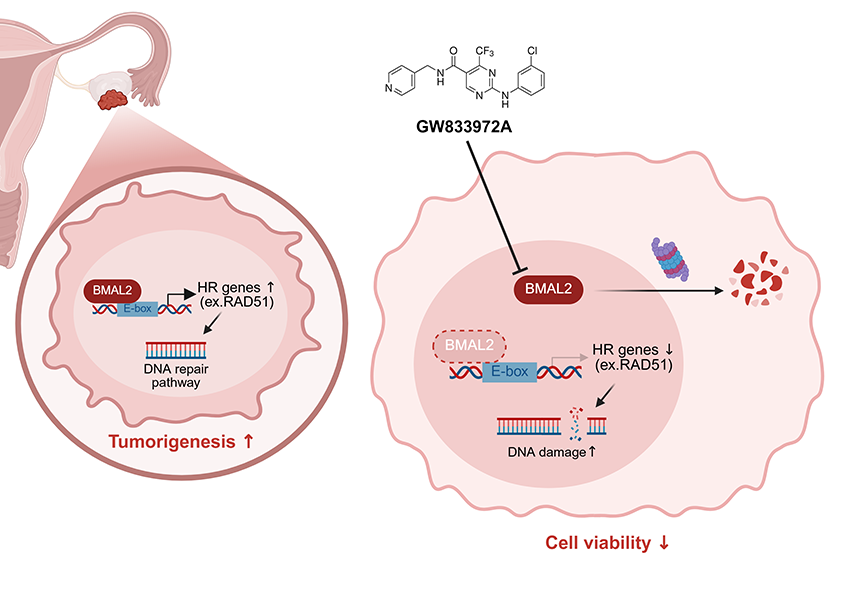
In OCCC, BMAL2 upregulates homologous recombination DNA repair genes, such as RAD51, to prevent endogenous DNA damage to promote tumorigenesis. Small molecule GW833972A can bind and facilitate BMAL2 protein degradation, leading to accumulation of DNA damage, inhibition of cell viability and suppression of tumor growth.